
StarckHouse.club
What people said: the Starck × 3 Suisses house in the press, among critics and in museums
Chapter 10 of 13 8 min read Contents
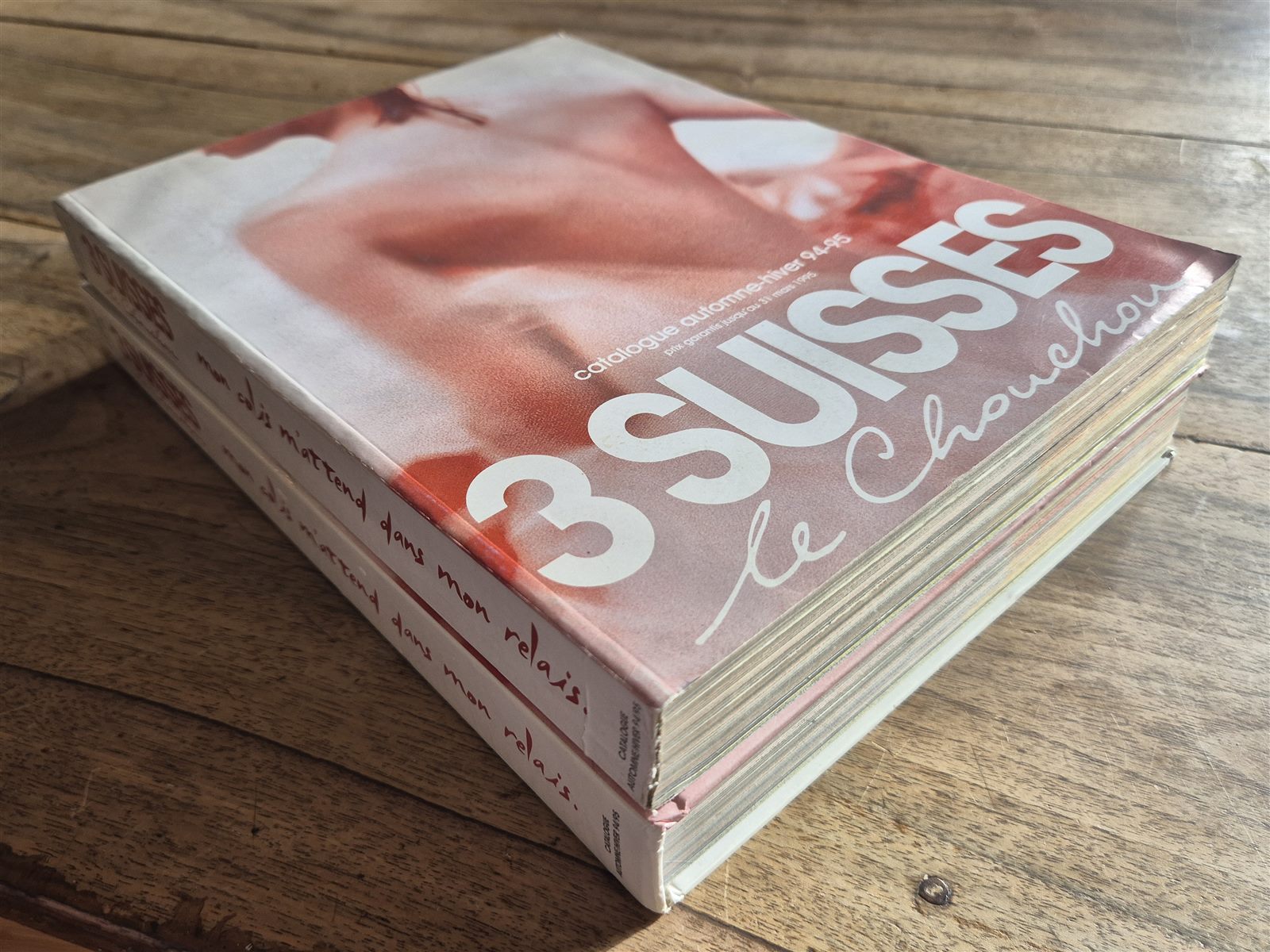
Since 1992, the Starck house for 3 Suisses has prompted articles in at least seven languages, reviews by architects, academic studies and interest from museums. Here is what has been said about it, from the announcement to the present day. Full references are on the Sources page.
1992-1993: the announcement stirs reactions
As soon as it was announced, the Ordre des architectes (the French architects’ professional body) denounced « la démagogie et l’esbroufe » [“demagoguery and showing off”] (Le Nouvel Observateur, 1992).
Starck, for his part, would speak of a « guerre commerciale » [“commercial war”].
The full story is on the History page.
1994: the French press
Paris Match hailed « Sa maison en V.P.C. » [“His mail-order house”], an « événement sans précédent » [“unprecedented event”] in mail order, which is « pas une maison en kit mais une création originale » [“not a kit house but an original creation”].
Le Point described it as « entre le pavillon chinois, la maison russe, la maison californienne et la cabane au Canada » [“somewhere between a Chinese pavilion, a Russian house, a Californian house and a log cabin in Canada”], for 138 m² and an estimated cost of 850,000 francs.
The architecture journal AMC ran the headline « Maison-mallette » [“Briefcase house”] and warned: « tout architecte se doit de prendre connaissance du catalogue automne-hiver 1994 des 3 Suisses » [“every architect ought to take a look at the 3 Suisses autumn-winter 1994 catalogue”].
Art press saw in it « un petit nid qui refléterait le bonheur de chacun » [“a little nest that would reflect everyone’s happiness”].
Le Monde, for its part, said nothing about it on release: its only article on the subject in 1994 is a January interview in which Starck answers « Oui, je fais un métier différent » [“Yes, I do a different job”] to the question about the house, just after saying that he is not an architect.
The foreign press
- Germany. Der Spiegel announced the release in July 1994 (about 1,400 marks), then in November published a long interview with Starck. In it he speaks of « action subversive » [“subversive action”] and announces the rest of the collection.
German critics felt that buyers would get “one Starck house among so many others”, all alike. A representative of the prefabricated house builders found the idea more expensive than their kits, and contrary to German law. Orders, the magazine noted, were getting off to a “timid” start. In the letters page, a future architect pointed out that a good designer is not necessarily a good architect, and another reader that land costs too much. - United Kingdom. Design Week (January 1995) interviewed Daniel Richard, who admitted: “we won’t sell an enormous amount”. French design critics, the magazine reported, considered the house (financially) out of reach for most of the catalogue’s readers. The Sunday Times Magazine gave it six pages in July 1994.
- Italy. Casa Vogue published “Starck in kit” in October 1994. Its author, Yves Marbrier, was an art director at 3 Suisses, so it was not an entirely independent review. In 1995, Ottagono noted that Starck the architect is “meno considerato dalla critica”, less highly regarded by critics than Starck the designer.
- Spain. As early as 10 October 1992, La Vanguardia carried the AFP dispatch announcing the project, and in 1994 it pointed out that the catalogue had a print run of 7 million copies.
- United States. In 1994, Architectural Record presented a 135 m² “model house”, “half pagoda, half cabin”.
- Brazil. The Domingo magazine of the Jornal do Brasil gave it four pages on 13 November 1994, with photos by Jacques Dirand and a sketch by Starck. Exame VIP wrote about it in 1995.
- Sweden. In 2001, the magazine Form used it as an example of ecological design.
Japan studied it from 1995
The house caught Japan’s interest very early on. In 1994, the journal 10+1 published an article by Kenji Oki on Starck’s design.
The architecture journal SD – Space Design debated it in 1995, in a column co-written by Atelier Bow-Wow, and again in 1997.
A management research group even made it a case study in Diamond Harvard Business in July 1995: the house sold by catalogue became an example of value creation.
Architecture critics
- As early as 1996, Le Monde counted « la maison vendue par correspondance » [“the mail-order house”] among Starck’s classics.
In 1997, it used it as a benchmark for expense: a detached house « moins chère que Starck, plus chère que rien » [“cheaper than Starck, dearer than nothing”].
In 1998, it noted that the plans were « quotidiennement réclamés » [“requested daily”], and that « avec les 3 Suisses […] la rupture est consommée » [“with 3 Suisses […] the break is complete”]. - L’Architecture d’aujourd’hui (1997) poked fun at it: « il aurait pu poser avec un top model pour vendre sa maison par correspondance » [“he could have posed with a supermodel to sell his mail-order house”], before admitting that it is possible to « populariser et de faire aimer l’architecture en utilisant les codes du spectacle » [“popularise architecture and make people love it by using the codes of show business”].
- Researchers at the LAUA laboratory (1999) observed that the offer, which takes up the idea of the cabin and of self-building, « coûte plus chère qu’une maison traditionnelle » [“costs more than a traditional house”].
- The Guggenheim in New York mentioned it in 1998 in its major survey of French creativity, Premises: Starck had designed for 3 Suisses “furniture and even a house”.
In 2000, Bernard Blistène included it in his history of 20th-century art. - Christine Desmoulins wrote in 2002 that « nul n’a oublié » [“no one has forgotten”] the 1994 catalogue. The same year, the American book Prefab placed Starck in the tradition of the Sears catalogue houses.
- A research report on Marne-la-Vallée (2008) criticised Starck’s rhetoric against suburban houses: an « injonction au bon goût » [“injunction to good taste”], as if people no longer had any excuse for their unsightly houses.
Whose house is it?
In 2014, the architect Patrick Bouchain, who drew up the plans with Loïc Julienne and Jean-Marie Mandon, claimed the house in an interview published in a doctoral thesis: « En regardant l’œuvre de Philippe on voit bien que cette maison est à nous et pas à lui, il n’a jamais produit un truc pareil » [“Looking at Philippe’s work, you can clearly see that this house is ours and not his; he never produced anything like it”]. His claim rests on credits published as early as 1994: « une idée originale de Philippe Starck, réalisée par Patrick Bouchain, concepteur, et les architectes Loïc Julienne et Jean-Marie Mandon » [“an original idea by Philippe Starck, carried out by Patrick Bouchain, designer, and the architects Loïc Julienne and Jean-Marie Mandon”].
Museums
- 1996: 3 Suisses donated box no. 006 to the French national collection (Centre national des arts plastiques). It was exhibited in Taipei in 2001 and in Seoul in 2002, and probably also in Miami Beach in 2011.
- 2006: the Centre Pompidou received box no. 195. It is on loan until 7 March 2027 to the Galerie nationale du design in Saint-Étienne, for the exhibition “Design en main”.
- 2017: 3 Suisses donated box no. 012 and a glazed box-frame to the Musée des Arts décoratifs, together with other Starck objects, including the Dadada stool.
- According to a London bookseller, no major architecture library holds one: not the CCA in Montreal, nor the Getty, nor MoMA, nor the British Library.
The official story
Today, Philippe Starck’s official biography presents the house as « historique » [“historic”] and makes him, as early as 1992, a « précurseur d’une architecture écologique et démocratique, à l’heure où les maisons en bois sont encore quasiment interdites » [“pioneer of an ecological and democratic architecture, at a time when wooden houses are still all but forbidden”].
The phrase is an exaggeration, as is often the case with Starck: no rule prohibited timber-frame houses in France in 1992, even if the industry, insurers and habit held them back.
Since 2023, galleries in Paris and New York have shown the box as an “iconic” object, sometimes describing it as “largely utopian”. Yet this site lists houses that were genuinely built.
In the profile that L’Architecture d’aujourd’hui devotes to him in issue no. 444, the box this time becomes « une opération politique » [“a political operation”] (as I wrote a few lines above, the phrasing is often exaggerated with Starck): Starck denounces a « loi scélérate » [“wicked law”], the one that left detached houses to building firms, without an architect.
His ambition has grown since: « produire une maison pour tous au prix d’une voiture » [“to produce a house for everyone for the price of a car”].
As early as 1995, a book about the fashion world summed Starck up in one phrase: « lancé par Mitterrand, rattrapé par les Trois Suisses » [“launched by Mitterrand, caught up by the Trois Suisses”].
After Starck, in Germany
The designer house sold from a catalogue then became a genre in Germany: Matteo Thun designed “O sole mio” for the manufacturer Griffner around 2004, followed by Jette Joop, Luigi Colani and Gustav Peichl (thesis by M. Köck, 2021). As early as 1997, Spiegel was already listing “prefabricated houses” in its inventory of Starck objects.
What the public says today
On blogs, forums and under videos, the house still draws reactions. Here are a few:
« Cette maison vendue en kit sur catalogue m’a fait rêver alors que j’habitais dans un HLM, elle semblait accessible. » [“This kit house sold from a catalogue made me dream when I was living in council housing; it seemed within reach.”]
an internet user, Reddit, 2026
« J’avais acheté le catalogue 3 Suisses exprès. » [“I had bought the 3 Suisses catalogue specially.”]
in a comment on an Instagram post by the Ketabi Bourdet gallery, 2026
I have been dreaming of this house for decades … now a mother of 3, I would love to build one !
Delphine M., 2021
« Pour moi, cette maison, c’était vraiment la maison de mes rêves d’enfant. » [“For me, this house really was the house of my childhood dreams.”]
the builder of the house in Aix-en-Pévèle, 2023
« Le plus difficile, en architecture, c’est de faire simple […] Starck a réussi. » [“The hardest thing in architecture is to keep it simple […] Starck succeeded.”]
the owner of the house in Jegun, 2021
« Je l’ai toujours adorée cette maison, je ne comprends pas qu’elle n’ait pas marché… » [“I’ve always loved this house; I don’t understand why it didn’t catch on…”]
a blog reader, 2013
« Quid de l’isolation avec ces 60 fenêtres ? » [“What about the insulation, with those 60 windows?”]
a reader of La Dépêche, 2021
« 5000 balles le plan, hein. Pas les matériaux ni main d’œuvre. » [“5,000 quid for the plans, mind. Not the materials or the labour.”]
an internet user, Reddit, 2026
The liveliest debate today concerns thermal comfort and the large glazed areas. In 1994, Starck replied that his house was « presque pour moitié en verre multicouche » [“almost half made of multi-layer glass”].
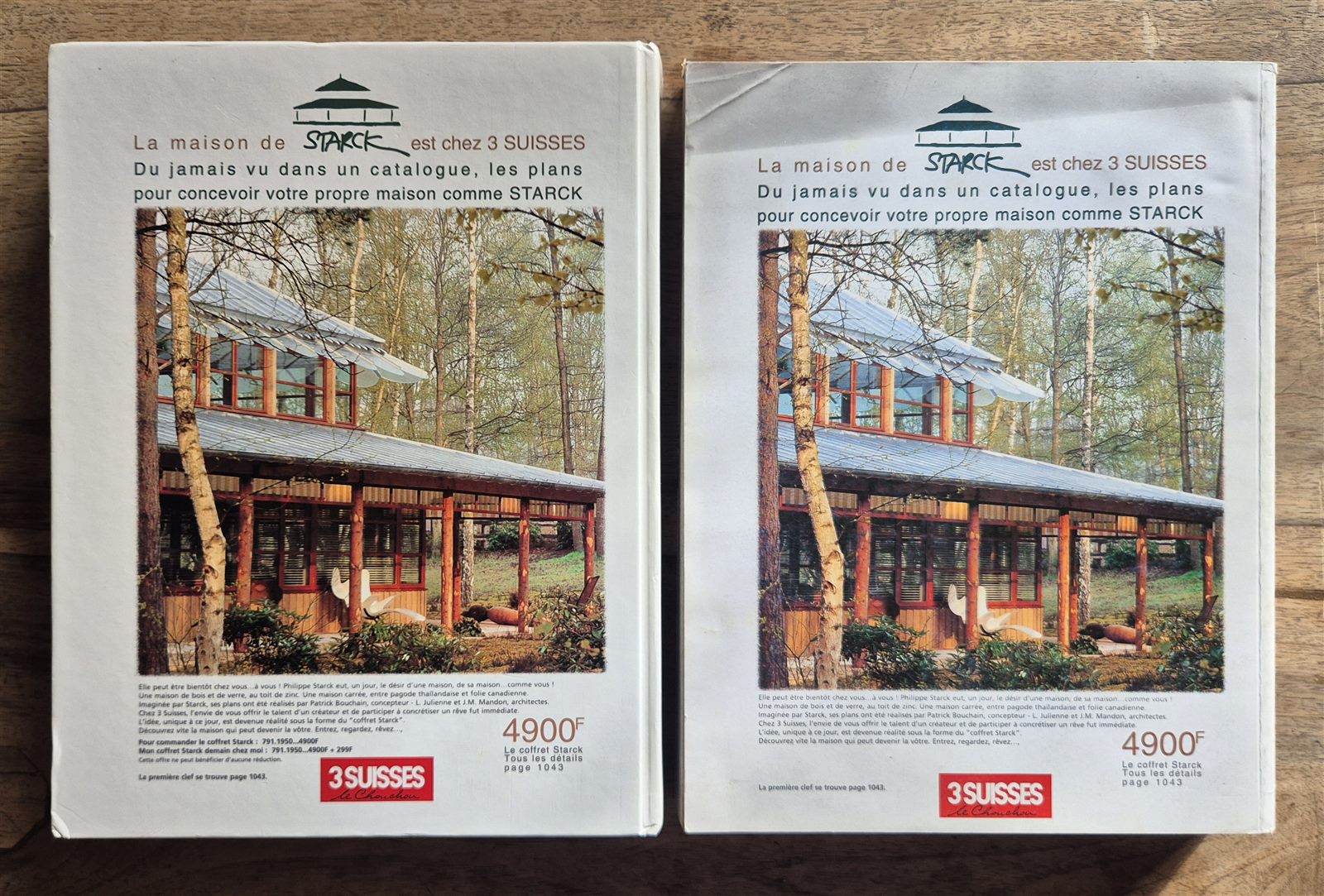
Documents reproduced on this page: the covers of the 3 Suisses autumn-winter 1994-95 catalogue. They remain the property of their authors and rights holders, and are shown for documentary purposes, to tell the story of the box, with no commercial use. Are you a rights holder and would like a document to be removed? Write to me: it will be removed without delay.