
StarckHouse.club
Anecdotes about the Maison Starck 3 Suisses boxes
Chapter 9 of 13 7 min read Contents
Unsold boxes?
The number of boxes produced is not known.
The known box with the highest number is box no. 527.
And apparently, we know even less about the number of boxes sold!
The seller of box no. 222 told a buyer that he had acquired 3 boxes at a sale of containers of unsold 3 Suisses goods.
The strangest thing is that this box has a number from the middle of the production run.
Perhaps that means the boxes were not distributed in order?
Or it could just as well mean that some buyers changed their minds in the end and sent their boxes back for a refund.
If one of the reasons is that some buyers returned their boxes, it is because they thought better of it and decided it was madness, or because they could not get a building permit.
In that case, in fact, they had 6 months to return the box and get a refund. 6 months seems short to me, but let’s move on…
How many boxes?
The exact print run is not known. Most sources, including Philippe Starck’s press kit and the Demisch Danant gallery, speak of 500 copies. An Artcurial catalogue entry gives “81 / 300”…
The register, for its part, knows of two numbers above 500: 501 and 527.
One hammer? Several hammers?
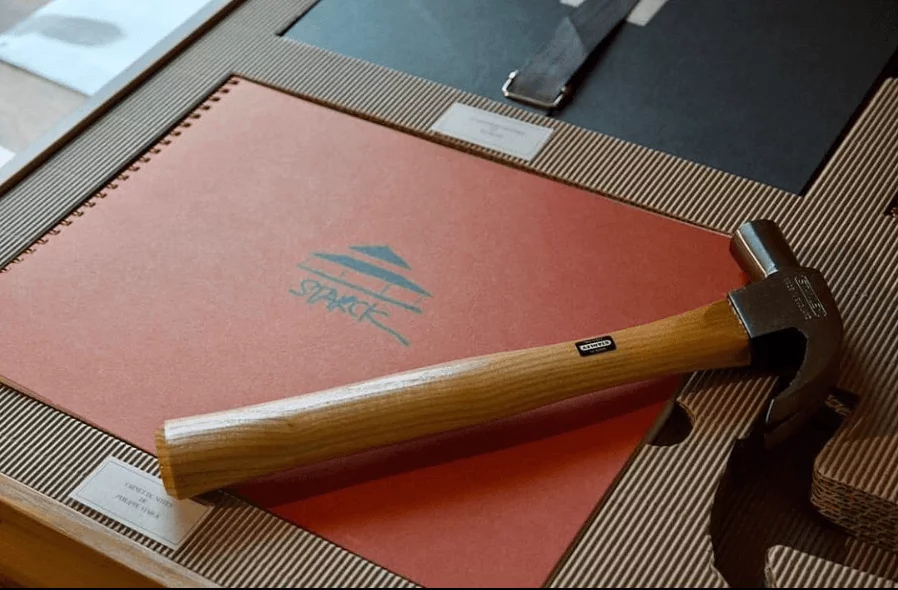
If you have studied the photos of the known Starck house boxes, you will have noticed that in some boxes the slot for the hammer is much longer than the hammer itself.
There are indeed two types of hammer:
long hammers and shorter hammers.
The first boxes in the series have the long hammer the slot was designed for. The following ones were then fitted with the shorter hammer.
This change was made somewhere between box no. 095, which still has a long hammer, and box no. 147, which already has the short version.
Even the glazed display piece that 3 Suisses gave to the Musée des Arts décoratifs in 2017 contains a short hammer: it was probably assembled after the change of model.
The long hammers are Stanley, reference 5211; the brand’s French head office and some of its workshops were in Besançon, in the Doubs (25000), when the boxes were made.
The short hammers are Stanley too, but this time reference 51 493. The one in box no. 527 is marked “Made in England”, with the reference 51-493 and a weight of 13 oz (about 370 g).
So Stanley seems to have replaced the planned hammer during production with another model from its range, probably for lack of stock.
Nearly 30 years later, and working with Stanley today, I can only note, sadly, that they still have not managed to improve their reliability as a supplier.
Box no. 006, given by 3 Suisses to the Centre national des arts plastiques in 1996, is described in its catalogue entry with a « marteau de charpentier Stanley n° 52 11 » [“Stanley carpenter’s hammer no. 52 11”].
In the museum’s photo, this hammer fills its whole slot: it is indeed the long model.
So we have two references: the original Stanley no. 52-11, then the shorter Stanley 51-493.
If you have a long hammer, the reference engraved on its head would confirm this spelling. (CNAP entry)
The short hammer, for its part, has been found in an English catalogue.
The 1993 Stanley hand tools catalogue, held at the Museum of English Rural Life at the University of Reading, lists in its Handyman range a 13 oz (365 g) carpenter’s hammer, 293 mm long, with an ash handle: the H202.
Its weight and handle match the short hammer in the boxes. The reference 51-493 engraved on the hammer of box no. 527 does not appear there, and the hammer still needs to be measured to confirm.
The long hammer remains untraceable: neither this catalogue nor the October 1995 price list contains a reference beginning with 52.
Was the Stanley no. 52 11 reserved for the French market, and made by Stanley France in Besançon?
Could the French have bigger hands than the English, for reference 52-11 to be longer than the English version 51-493?
If your box has a long hammer, look at what is engraved on its head or handle, and write to me.
Thanks to the Tools and Trades History Society, which passed on my question, and to the Museum of English Rural Life, which searched its catalogues and sent me the hammer pages the very same day.
And why a hammer?
Philippe Starck explained it to Spiegel in November 1994: it is there so that people take part in building their own house, the opposite of the “Kleenex houses” sold from catalogues.
The critic Conway Lloyd Morgan was amused by it in 1999: “you even have a free hammer to start the work with!”
Six months to send the box back
The catalogue allowed 15 days for returns, as for any other item.
But a clause, tucked into the « mode d’emploi à lire impérativement » [“instructions you must read”] on page 1043, extended this to 6 months if the building permit was refused, with proof of the refusal enclosed with the box.
So 3 Suisses took account of a risk specific to this product: you bought the plans of a house before knowing whether you would be allowed to build it. The full text is on the page the box in the catalogue.
But frankly, 6 months is still very little given the clause.
Do you think that in 6 months you could buy a plot, find an « homme de l’Art » [a qualified professional], as they put it, apply for a building permit and have it refused? Perhaps that was possible in 1995, … but I have my doubts.
Did a buyer ever send their box back for this reason? If you know of one, write to me!
Plans that do not all show Starck’s house
The box contains 16 drawings, numbered 0 to 15 and all dated « Paris – avril 94 » [“Paris – April 94”]. Once folded, each one carries on its cover a thumbnail captioned « La maison de Ph. Starck » [“Ph. Starck’s house”].
On drawing no. 2, the upper-floor plan, the thumbnail shows the floor as it is in Philippe Starck’s house: a single large bedroom, with the bath set at an angle. The same thumbnail appears on drawings no. 14 and 15, the electrical and plumbing diagrams.
The blue drawing itself, however, divides the floor into seven rooms: utility room, study, bathroom, WC, landing, parents’ bedroom and children’s bedroom. The schedule of areas printed on each drawing follows this version: two bedrooms of 14 m², a study of 11 m², a bathroom of 8 m²…
So the plan was redrawn for the version sold through the catalogue, but the thumbnail remained that of the original house.
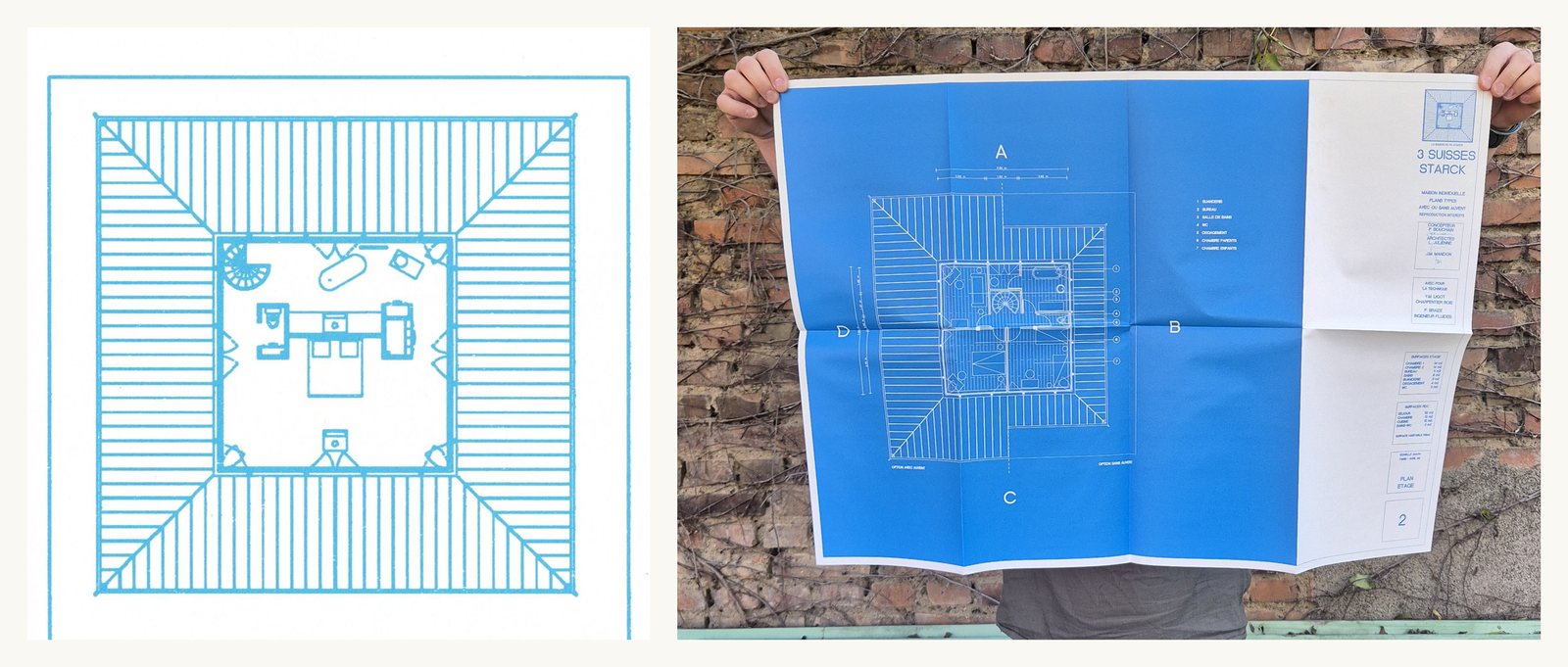
Another detail: in box no. 527, drawings no. 2 and 14 are not printed quite like the others. The blue of their covers is slightly lighter, as if they had been reprinted separately.
Do you have one of the early boxes? By comparing its drawings no. 2, 14 and 15 with those of no. 527, we would know whether these drawings changed during production. Write to me!