
StarckHouse.club
My view of the Starck × 3 Suisses house
Chapter 13 of 13 6 min read Contents
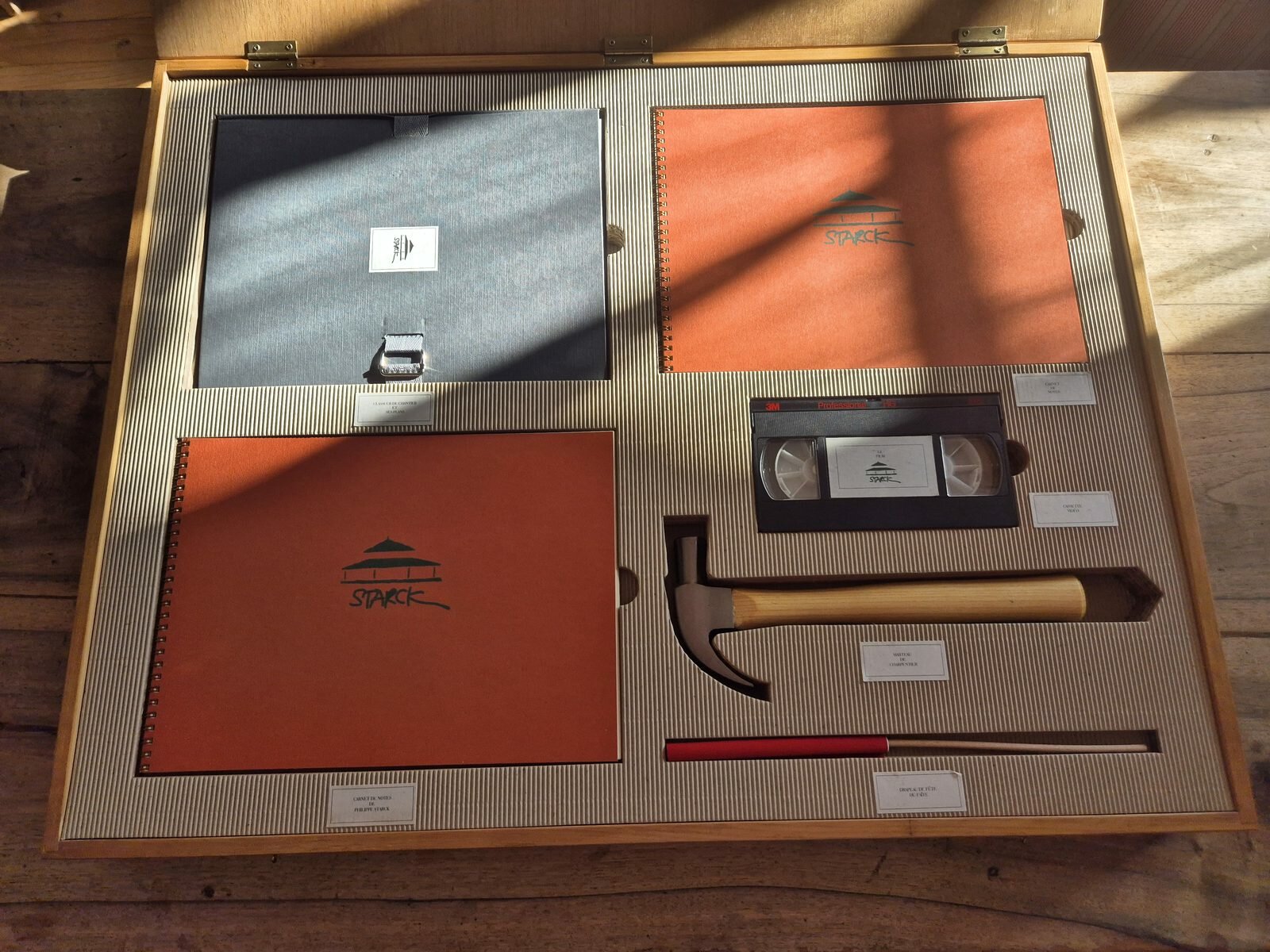
I collect this box, but I am not a blind fan.
I have had my reservations about the project for a long time: I was already writing them down in 2012, in a comment on a portrait of Philippe Starck published by Terra eco.
The research of recent years has made me change my mind on some points, and confirmed my view on others. Here is where I stand.
A house for everyone, in a single model
Starck presents his house as an answer to the soulless suburban houses sold from catalogues in the early 1990s.
Yet the box contains only one plan: the same house for everyone, whatever the plot, the region or the family.
One thing must be granted: the house is designed to grow. With one more child, you add a bedroom.
As a result, all the houses built are different.
In Jegun, the owner used standard off-the-shelf windows, hence more than sixty windows.
In Saint-Malo, on the contrary, they were made to measure, and enormously large.
Yet all these houses look alike. Starck’s silhouette wins out over everyone’s choices. Spiegel predicted it as early as 1994: each buyer would have “one Starck house among many”.
I have softened this criticism, though, since learning that the Starck house was meant to be only the first. Starck wanted Frank Gehry, Jean Nouvel, Aldo Rossi or Norman Foster to take over, one house a year. Had 3 Suisses kept to this programme, France would today have hundreds of houses by great architects, all different.
The series stopped at the first issue. Perhaps because Starck attracted as much criticism as he did attention.
Affordable, really?
The project was meant to be popular, sold in the catalogue that almost every French household received.
But the technical file estimated the build at between 850,000 francs without the canopy and 1,150,000 francs with it. That price includes neither the land, nor the design studies, nor the fees. Critics saw it straight away: Design Week in 1995, Le Monde in 1997 (« moins chère que Starck, plus chère que rien » [“cheaper than Starck, dearer than nothing”]), researchers in 1999 (« plus chère qu’une maison traditionnelle » [“more expensive than a traditional house”]).
The land weighs heavily. With its 150 m² canopy running all round the house, its symmetrical façades and its four roof slopes, the house is made to be seen from every side.
It needs a large, open plot, and that plot pushes up the bill.
It is not a house for a housing estate.
The house in Saint-Malo, however, is built on a cramped plot.
A house without an architect… that needs an architect
Starck wanted to denounce the law that exempts houses under 170 m² from using an architect.
In 1994 he said he had « tout construit sans architecte » [“built everything without an architect”]. His house was to be within everyone’s reach, with a hammer in the box so you could roll up your sleeves.
But the catalogue required the help of a professional to adapt the plans. And in January 1994, when Le Monde asked him why he was putting his name to a house, he replied: « je ne suis pas architecte » [“I am not an architect”].
And all the known built houses show that every one of them went through an architect’s hands.
You sense that the work was not carried through to the end. The box contains a list of parts and drawings that are mostly presentation drawings. The real instructions for building it yourself are missing. And the blank notebook? Was it there to take the place of something that never came?
Starck’s work is steeped in contradictions, to the point that contradiction becomes its hallmark.
Whose house is it?
The plans are not by Starck.
The credits of the tape say so: the house is « une idée originale de Philippe Starck, réalisée par Patrick Bouchain, concepteur, et les architectes Loïc Julienne et Jean-Marie Mandon » [“an original idea by Philippe Starck, carried out by Patrick Bouchain, designer, and the architects Loïc Julienne and Jean-Marie Mandon”].
In 2014, Patrick Bouchain went further: « cette maison est à nous et pas à lui » [“this house is ours and not his”].
The Starck house is perhaps above all a Bouchain house, with a famous signature.
A collector’s item, and by design
The box was numbered, and it allowed only one build.
Everything was in place to make it a rare object.
In 2001, an auction house still estimated it below its original price.
Thirty years later, it sells for several thousand euros (see the price history), and some sellers ask €6,500 to €8,500.
Many of its buyers will never build the house (6 known houses for more than 500 boxes sold). I am one of them. It is the opposite of what the project announced: a house to be built, not an object to keep in a cupboard.
The Starck paradox
This is the criticism I made in 2012, and I stand by it.
Starck denounces the disposable, yet he has designed many short-lived objects.
He champions design for all, while his objects cost more than their unsigned equivalents.
And by being a designer whose face everyone knows, his creations age along with his persona, and become dated.
If you are interested in design, you instantly recognise any object designed by Starck, and the decade it was made.
Rather few of Starck’s objects have become timeless (the lemon squeezer, so iconic that it is simply called THE lemon squeezer, the Louis Ghost chairs, and perhaps, in a class of its own, the Attila stool); the others have a use-by date.
Twenty years later, P.A.T.H.
In 2014, Starck launched the P.A.T.H. prefabricated houses with the manufacturer Riko.
He presents them as timber houses, delivered in a few months, at a cost close to that of social housing.
In the plans, depending on the size, you can recognise the touch of the 3 Suisses house.
But above all you recognise one of Starck’s graphic signatures of the 90s: that flared cornice roof.
The promise is the same as in 1994: an architect-designed house affordable to as many people as possible.
His official biography in fact names the 3 Suisses house as the origin of P.A.T.H.
Why I am interested all the same
Despite everything, this project stands apart.
An architect-designed house sold by mail order to anyone who wanted it, with complete plans and a video: nobody in France had done that before. Its contradictions are part of its story, and I would rather show them than hide them.
And the “commercial” project of 3 Suisses to transform the French landscape fascinates me!
Imagine ordinary people’s houses signed by Frank Gehry, Jean Nouvel, Aldo Rossi, Norman Foster, or Ieoh Ming Pei…
France’s standing would have been strengthened in many respects.
But sadly the gamble was soon lost.
Choosing Philippe Starck as no. 1 of this series was a very risky bet because of his personality and his image.
Alban