
StarckHouse.club
The Starck 3 Suisses box video
Chapter 8 of 13 10 min read Contents
In the Starck box, between the plans, the building binder and the hammer, there was a VHS tape.
On it, Philippe Starck presents his house: nine minutes to understand where the idea came from and what the built house looks like.
Read the video transcript
Transcript based on YouTube’s automatic subtitles, then corrected, and translated here from the French. A few words remain uncertain. Unless otherwise stated, the speaker is Philippe Starck.
0:14 This house is a bit like the schematic childhood house I never had. I mean, I must be regressing, or else perhaps I’ve reached the collective unconscious. This house comes straight from the tests we used to do as children, at school, when we went out into the street and went to see people. We’d ask them: “What’s the colour?” They’d say: “Red.” “What’s the musical instrument?” “The trumpet.” “What’s the tool?” “The hammer.” “What’s the animal?” “The lion.” And of course, if you asked: “What’s the house?”, they would draw this extremely schematic house like this, with the four slopes. That’s the house, the childhood house.
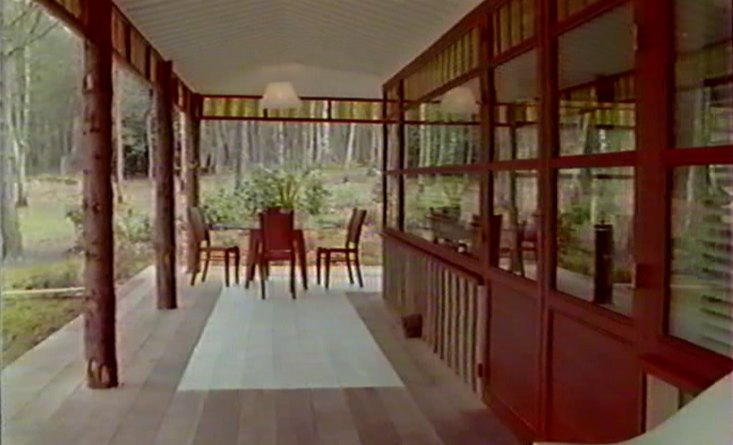
1:32 So the important thing, for us, is to multiply the ways of making the house your own. Now, a house needs a roof, and to hold up a roof you need columns. So this house has sixteen columns. We did it on purpose, and it’s Patrick Bouchain’s idea, by the way, an excellent one: to take rough tree trunks, so that people touch them. So I’m going to do it first, right: I bought myself wood gouges and wood chisels, and I started carving. I did my column, my own totem, and my fiancée is going to do another, and my daughter another. And since there are indeed a lot of them, well, all my friends are going to do one. And when they arrive in this house, it won’t be a friend’s house: it will already be their house too, because the house where they’re going to spend the weekend or a few days, well, already has something of theirs.
2:45 Patrick Bouchain: What I like about Philippe is that simple way of describing things, and that in the smallest little drawing he makes, the essentials are there, so much so that you want to build it. And when you think like that, everything is simple. We know that, well, there you are, we like a wool jumper because it’s warm and it doesn’t itch; we know we like a hat, or whatever, and so on. Well, he imagined this house in that way, which is: “I describe what I want in relation to what I’ve seen”, because he is well nourished by what he has seen. It really is a house imagined by a contemporary, produced by contemporary firms, in real time, with the things on the market. This house was made so that there is a central unit, the unit you’re sure of, but so that the canopy, with the walkway all the way round, already forms the ceiling and the floor. In other words, since this house is symmetrical, if I need to, if I have another child, well, click, click, click, in about 48 hours I build the bedroom, the bathroom. I need a study? Well, click, click, click. In other words, this unit is designed, here too, to be extendable.
4:00 Today, if you look at houses, 90% of houses, apart from a few little farmhouses tucked away deep in a forest, are not there for the pleasure of the people who live in them: they are there to show off. I mean, you’ve worked all your life, you’ve saved up, and as soon as you build your nest, well, it isn’t going to become a nest: it’s going to become a weapon to crush the neighbour, to look down on him, to show him that we’ve done well in life, we’ve got the dosh. “Look at you, still in a shack; look at me, I’m in a castle.” And French architecture, the vice of French architecture, in fact, and that’s… we are all Louis XIVs.
5:04 Since the prototype was finished, people turn up and say: “Oh, but that’s a Chinese pavilion!” Well, yes, why not. Another one turns up: “Oh, a Russian isba!” Well, yes, of course, yes. “Oh, it’s completely Californian.” No doubt. “Oh, what a delightful little hunting lodge! You could imagine it at the far end of the park at Versailles.” Yes, yes, of course. And everyone finds their own house in it. And that is vital: just as you have to find your place, just as you have to find the love of your life, just as you have to find your sound, just as it’s desirable perhaps even to find your painting, your image, well, you have to find a house of your own.
5:52 The only way to make my experience known, my adventure for my house, and for everyone’s house, what I hope is the right house, was obviously the Trois Suisses. The Trois Suisses, in other words mail order, in other words a popular medium, in the noble sense: something that is known and read by almost all French people.
6:13 I’m talking about a house that has no preconceived idea at its root, which starts, I repeat, a little from that informal outline that everyone has somewhere in their head, of a house like this. But that’s not so important yet, that’s a bit the shape it will take. Above all, we’re talking about the pillow. We’re talking about the pillow: when I get up, what am I going to see? What am I going to see around me? And on Saturday morning, I don’t have to work, I’m going to have breakfast with my family, and then, well, I’d like there to be a ray of sunshine, a lovely ray of sunshine falling on my teapot. And afterwards, well, I’ll move around, I’ll go and work a little at my table, and there too I’d like a lovely ray of sunshine to arrive at the time I’m at my table. And that’s what a house is: a house that goes from the inside out. It’s a house that will be beautiful if it reflects the happiness of the people who live in it. I mean, it’s a house that would draw its elegance from the happiness inside. And that’s fundamental. It’s fundamental, it sounds really obvious, but I think it’s something that has been dreadfully forgotten, and that’s why today our countryside and our towns are filling up with nonsense, and people are unhappy. So it’s a house that simply tries to reset the counters to zero. It’s not a showy house, there to show how well I can draw. It’s just a house that tries to be honest.
What the catalogue said
« Philippe Starck vous parle de sa maison. Une vidéo passionnante qui vous dévoile comment naît une grande idée. » [“Philippe Starck talks to you about his house. A fascinating video that reveals how a great idea is born.”]
Page 1043 of the 3 Suisses autumn-winter 1994-95 catalogue (see the box in the catalogue).
The tape from box no. 527
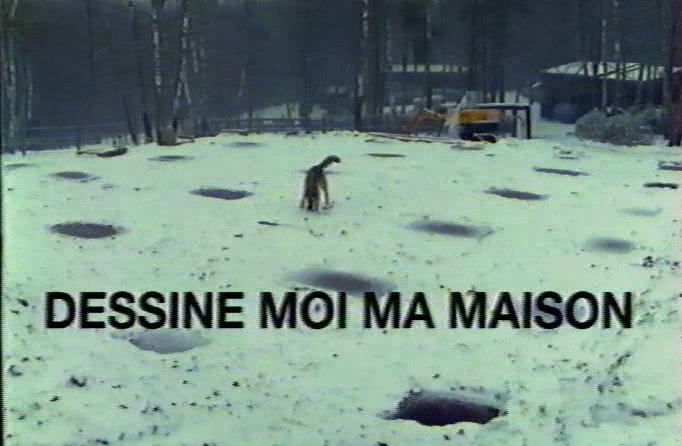
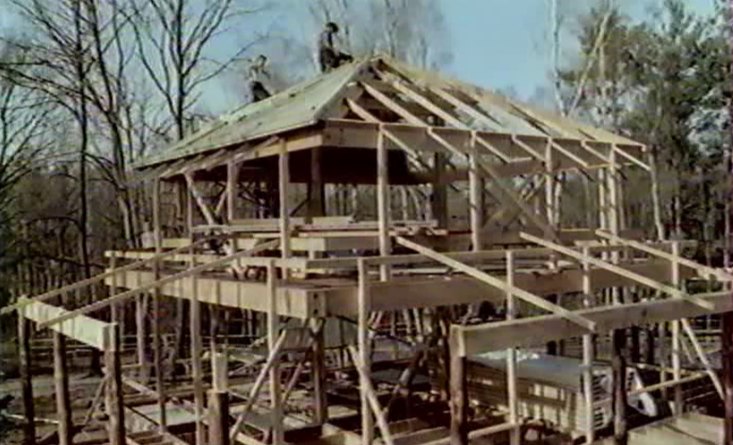
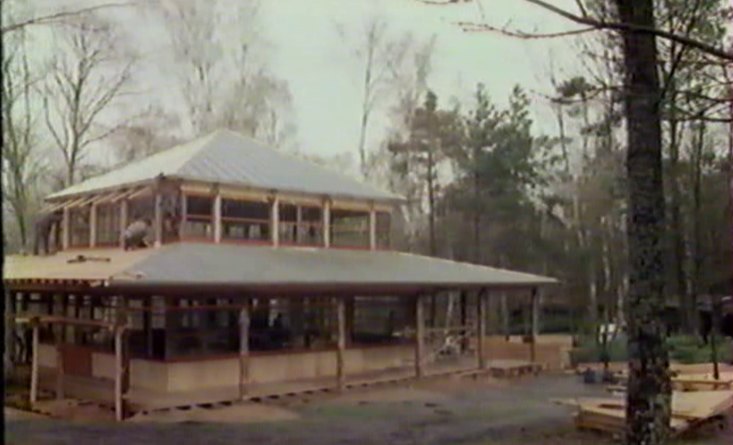
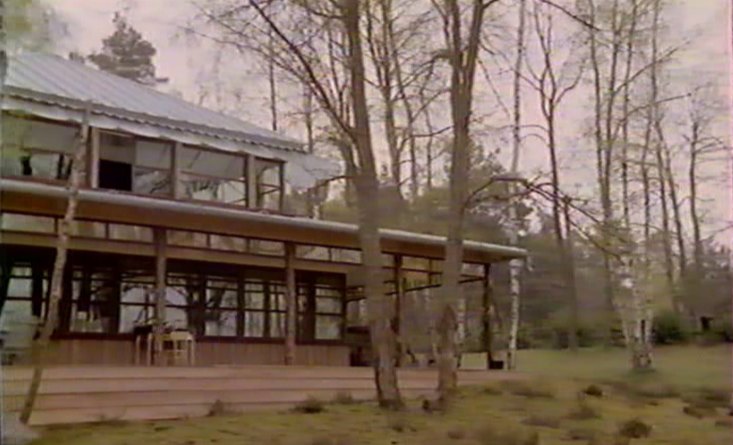
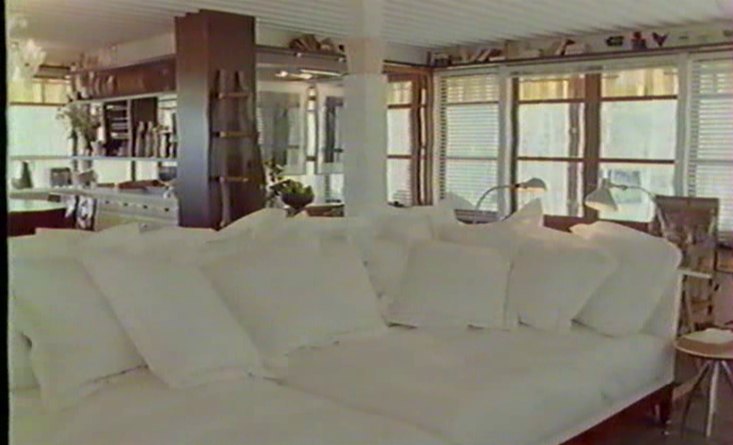
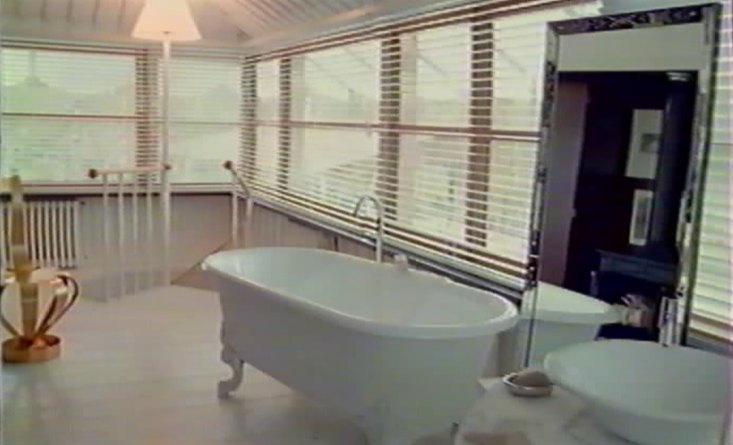
In November 2026, the tape from box no. 527 was digitised. The film lasts a little over nine minutes; the tape, an E-15, could hold fifteen. It is a 3M Professional HG VHS, and the picture is in widescreen, with black bars at the top and bottom. The film opens on a title: « Dessine moi ma maison » [“Draw me my house”]. Here are a few stills from this copy (film © 1994 Les 3 Suisses).
Why the YouTube video is in black and white
The film is in colour, as the digitisation of box no. 527 shows. Yet the copy uploaded to YouTube in 2009 is in black and white.
The explanation lies in the television standards of the time. In 1994, France encoded colour in SECAM, and tapes sold in France were recorded in SECAM. The United Kingdom, like most European countries, used PAL.
The two systems have the same picture, 625 lines and 25 frames per second, but encode colour differently. So a PAL video recorder plays a SECAM tape without any trouble… in black and white.
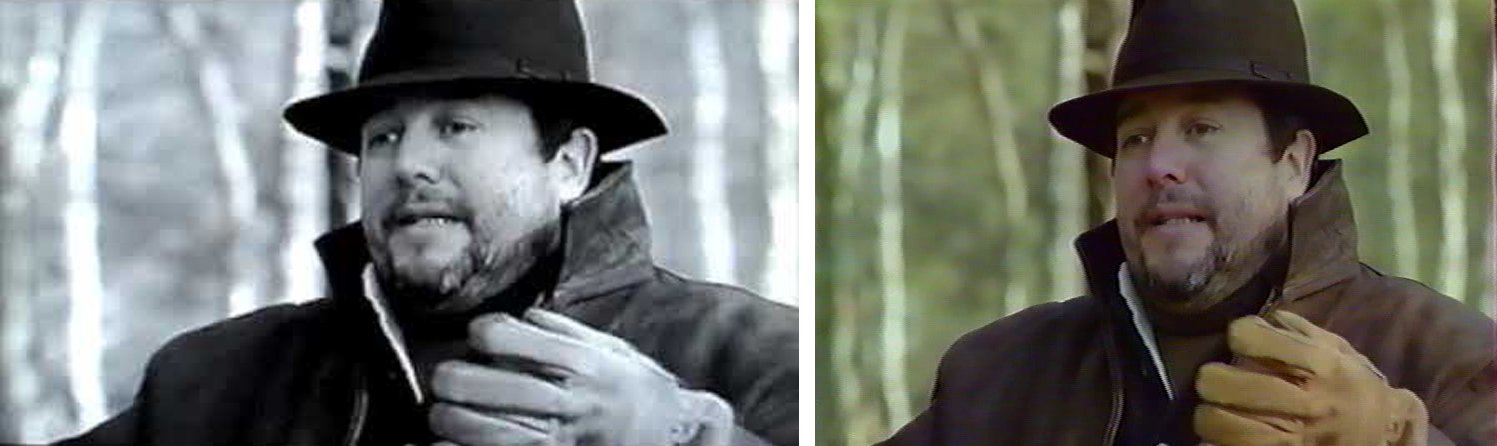
The person who uploaded the video is British: in the description, they are looking for “the original documentary that was on TV in the UK”. So the project would also have been the subject of a documentary on British television.
Did you see it, or do you know which one it was? Write to me.
The colour version is not yet shown here: in November 2026, I asked the film’s rights holders for permission to publish the full digitisation of box no. 527, and I am waiting for their reply.
The credits
The end credits, copied from the tape:
- Director: Benoît Ferreux
- Producer: Fabrice Coat, for Program 33
- Camera: Daniel Leterrier and Catherine Georges
- Editing: Amina Mazani
- Production manager: Laure Desbrueres
- Sound mixing: Jean-Michel Debord
- Music: Marc Perrone
« La maison de Starck est présentée par les 3 Suisses, sur une idée originale de Philippe Starck, réalisée par Patrick Bouchain, concepteur, et les architectes Loïc Julienne et Jean-Marie Mandon. » [“Starck’s house is presented by 3 Suisses, from an original idea by Philippe Starck, carried out by Patrick Bouchain, designer, and the architects Loïc Julienne and Jean-Marie Mandon.”]
The film thanks Jacqueline Courmont, of 3 Suisses, then Pierre Befve and Frédéric Vieille, and finally Ahmed Bejaoui, Frédéric Berthod, Eric Calvo, Stéphane Cohen, Gérard Croix, Franck Da Silva Bastos, Dominique and Pascal Delhoumeau, Emmanuel Drochon, José Goncalves, Jean-Luc Gournet, Ludovic Guyot, Serge Kramp, Yves-Marie Ligot, Jean-Yves Llobera, François Marchand, Stéphane Momy, Raymond Ségor and Jean-Pierre Texier: no doubt the building crew. Yves-Marie Ligot is the carpenter whose name also appears on the title page of the plans (see the technical file). The credits end with “(c) 1994 Les 3 Suisses”.
Other copies?
The video at the top of the page remains the copy uploaded in 2009: the film belongs to 3 Suisses, and the digitisation of no. 527 is not shown in full here. Do you have another tape from the box, or memories of the filming? Write to me.
Unanswered questions
The film nonetheless leaves two essential questions unanswered.
– Who is the dog crossing the snowy ground in the very first seconds, just before the title?
– And what are bears doing in the story!?
If you know the answer, write to me: it will be published here.
Documents reproduced on this page: the transcript of the video tape in the box and the 3 Suisses catalogue text. They remain the property of their authors and rights holders, and are shown for documentary purposes, to tell the story of the box, with no commercial use. Are you a rights holder and would like a document to be removed? Write to me: it will be removed without delay.