
StarckHouse.club
The history of the Maison Starck × 3 Suisses box
Chapter 1 of 13 10 min read Contents
1983: furniture designers enter the catalogue
The house did not come out of nowhere.
Since 1977, 3 Suisses had been commissioning designers to sign fashion collections.
The style agency M.A.F.I.A., founded in 1968 by Maïmé Arnodin and Denise Fayolle, the first communications and advertising agency set up and run by women, brought these designers into the catalogue (Universalis). In 1983, it opened “designer pages” there devoted to the home: Philippe Boisselier signed the first furniture collection, and Gae Aulenti the page for autumn-winter 1983-84.
Philippe Starck joined the catalogue in 1984, with the “Tertio” collection.
His objects were produced by the company XO, which he founded that same year with Gérard Mialet (according to the design historian Florine Barnet), and photographed by Tom Vack. The art director Yves Marbrier helped make him known. Until 1995, Starck had a double-page spread in every six-monthly catalogue, and his Bubu stool, sold at 199 francs a pair, sold more than 100,000 units there, according to 3 Suisses (Design Week, 1995). So the box crowned ten years of collaboration with the show-stopper: a house!
Standing out from La Redoute
Daniel Richard, head of 3 Suisses France, wanted his catalogue to stand apart from that of La Redoute, its great rival.
According to Les Échos Enjeux (2000), « la maison de Philippe Starck, l’introduction de la styliste Agnès B, du top model Bibi Russel ou de l’écrivain Ysabelle Lacamp permet aux 3 Suisses de se différencier de son rival » [“Philippe Starck’s house and the arrival of the fashion designer Agnès B, the top model Bibi Russel or the writer Ysabelle Lacamp allowed 3 Suisses to set itself apart from its rival”], even if « certains actionnaires de la famille Mulliez grognent » [“some shareholders from the Mulliez family grumbled”]. The Mulliez family was then a shareholder in the group alongside the German company Otto: as late as 2013, it held 44 %, against 51 % for Otto (La Voix du Nord, quoted by Wikipedia).
Houses from a catalogue? Starck didn’t invent anything. Nor did 3 Suisses.
Selling a house from a catalogue is not a new idea:
- in 1901, Frank Lloyd Wright sold house plans for 5 dollars in the Ladies’ Home Journal. Starck himself cited this precedent in 1994;
- from 1904, Gustav Stickley offered every subscriber to his magazine The Craftsman, for 3 dollars a year, a complete set of house plans (the February 1904 announcement; an example plan, 1909);
- from 1908 to 1940, the American mail-order company Sears sold more than 70,000 kit houses from its catalogue, delivered by railway wagon (the catalogue pages; on video: PBS, 2021);
- in the 1960s, the German mail-order companies Quelle and Neckermann sold prefabricated houses from their catalogues. Quelle was selling houses by catalogue from 1962, with the promise of “assembly in five days”. A 1966 Quelle house is now on display at the Kiekeberg open-air museum, near Hamburg (on video). Neckermann’s subsidiary is said to have built 25,000 houses in ten years, using a system designed by the architect Egon Eiermann (Hesse monuments record);
- in 1970, Neckermann’s subsidiary even offered the Futuro house by the Finnish architect Matti Suuronen, for 58,750 marks (Hobby, 23 December 1970). It is the only known precedent of an architect-designed house sold by a major mail-order company.
Others tried to industrialise the house, without selling it at a distance:
- in 1956, Jean Prouvé designed the “maison des jours meilleurs” [house of better days] for the Abbé Pierre, put up in seven hours. But it was refused approval: the officials would not accept a bathroom placed at the heart of the house (Galerie Patrick Seguin). Without certification, it was never mass-produced: only five were built;
- in 1969, the minister Albin Chalandon launched the international competition for the single-family house: the “chalandonnettes” sprang up in whole housing estates, built by the winning developers (on video on the INA website).
1988: a house for 3 Suisses, four years before Starck
At the “Habiter 88” show, organised by the VIA (Valorisation de l’innovation dans l’ameublement) at the Grande Halle de La Villette from 9 to 17 April 1988, the young architect Pascal Rollet presented a “house of the future”.
Four teachers and fifty students from the Grenoble school of architecture built it in nine days, with the CRAterre laboratory.
3 Suisses partly funded it to show off their furniture. Open to the public for two weeks, it was taken down in three days.
A book from the school speaks of a « concours lancé par la société 3 Suisses » [“competition launched by the 3 Suisses company”] (Terra nostra, 2018), but Pascal Rollet describes it rather as a partnership with the VIA (Solar Décathlon, ENSA Grenoble, 2014).
So the Starck house was not just Starck’s idea: it continued an interest in the house at 3 Suisses, under the leadership of Daniel Richard.
1992: the announcement
On 9 October 1992, an AFP news dispatch announced the project: Philippe Starck wanted to sell “architect-designed houses” by mail order. It is the earliest known announcement. The Spanish daily La Vanguardia picked it up the very next day.
Le Nouveau Quotidien of Lausanne ran it in French on 11 October, under the headline “Stark vend des maisons signées”.
It becomes clear that the project was no longer to sell a kit house, but only the plans: « Un dossier complet, prêt à être présenté à une entreprise de construction, comprenant les plans et le dossier du permis de construire » [“A complete file, ready to be presented to a building firm, including the plans and the building permit application”].
Between the announcement and the box, reality got the better of the “building permit application”.
On 27 October 1992, Le Monde published “Maisons sur catalogue”.
In it, Starck declared that « la France se couvre d’une lèpre : les lotissements individuels » [“France is being covered by a leprosy: housing estates”].
He was still planning to sell, for between 5,000 and 10,000 francs, « un dossier complet destiné à une entreprise de construction et à l’obtention du permis de construire » [“a complete file intended for a building firm and for obtaining the building permit”].
And he was looking further ahead: « Je voudrais qu’ensuite des architectes comme Frank Gehry, Jean Nouvel prennent le relais. Pour que tous les ans, une nouvelle maison soit proposée. » [“I would like architects such as Frank Gehry and Jean Nouvel to take over afterwards. So that a new house is offered every year.”]
The house was meant to be only the first in a collection.
According to the historian Franco Bertoni (1994), the original idea was a house “produced by a company known on the international market for its production and marketing of furniture”, which the buyer could modify.
Starck, for his part, presented it as a political act: he wanted to denounce the law that exempts private individuals building a house of less than 170 m² – almost every suburban house – from using an architect. Made, in his view, for the « constructeurs-voleurs » [“builder-thieves”] (portrait of Starck by Maryse Quinton, L’Architecture d’aujourd’hui, no. 444, reproduced in his press kit), it left housing estates to the developers, with no architect.
Where did the idea come from? In that portrait, Starck goes back to his childhood: a father who was an aeronautical engineer, a beautiful house near Mantes-la-Jolie that he used to gaze at from the road, the pages of the Sears catalogue, and a village of show homes visited by motorbike: « J’ai été choqué par le manque de qualité et d’honnêteté. » [“I was shocked by the lack of quality and honesty.”] He wanted the opposite: « Une maison honnête, sentimentale, avec de vrais matériaux qui ne vieillissent pas, mais qui se patinent. » [“An honest, sentimental house, with real materials that don’t age but acquire a patina.”]
The reaction was swift!
In D’A, the journal of the Ordre des architectes, its president, Rémi Lopez, judged that the project amounted to « la démagogie et de l’esbroufe » [“demagoguery and showing off”] (Le Nouvel Observateur, 1992).
According to the same article, the Ordre had even filed a complaint against him, « les lobbies des constructeurs avaient frémi » [“the builders’ lobbies had shuddered”] and « une émission de télévision avait censuré ses propos » [“a television programme had censored his remarks”].
January 1993: the announcement in Croix
On 8 January 1993, the FR3 Nord regional news announced from Croix, the headquarters of 3 Suisses, « une maison Philippe Starck proposée par les trois Suisses dans le catalogue 1994 » [“a Philippe Starck house offered by 3 Suisses in the 1994 catalogue”] (Europole news, 1 min 20; INA record of the report. It is not online, but it can be viewed at the Inathèque).
In 2002, France 3 reused a clip from that time in an archive feature on the history of mail order, freely available on the INA website. From 1 min 32, the journalist announces that « les 3 Suisses vendront l’hiver prochain une maison individuelle par correspondance. C’est la première fois qu’une cliente pourra choisir les plans de sa maison en même temps que son soutien-gorge. » [“next winter 3 Suisses will sell a family house by mail order. It is the first time a customer will be able to choose the plans for her house at the same time as her bra.”]
Note that at 3 Suisses they never spoke of a male « client », only of a female « cliente ».
Daniel Richard, then head of 3 Suisses in France, explains: « Un des talents de la VPC, c’est faire rêver, c’est faire travailler l’imaginaire de nos clients mais d’une façon accessible. » [“One of the talents of mail order is to make people dream, to set our customers’ imagination to work, but in an accessible way.”]
The house was then expected in the 1993-94 catalogue (Le Figaro Magazine, 1993). It would not appear until a year later, in the autumn-winter 1994-95 catalogue.
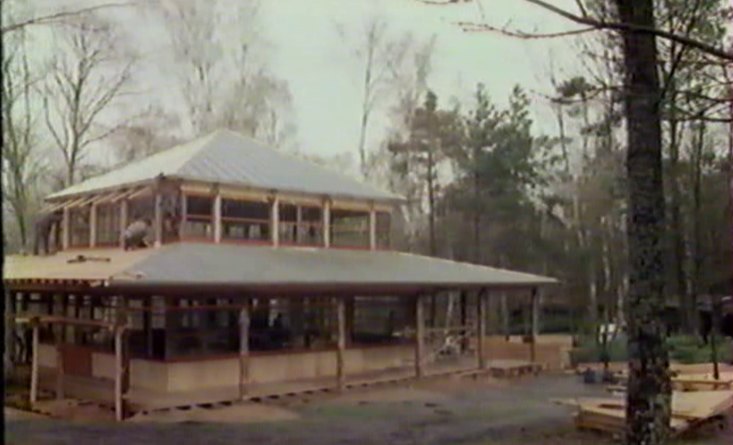
1993: the house goes up
Announced in the autumn of 1992, Philippe Starck’s house was built in 1993, more than a year before the box appeared in the 3 Suisses autumn-winter 1994-95 catalogue.
The box’s video shows the building site under snow. According to Météo-France’s daily records for the Paris region, it snowed from 20 to 28 February 1993, then again at the end of November and the end of December 1993. The filming very probably dates from the end of February 1993. In January 1994, Le Monde was already presenting the house as finished. Yet the box’s logbook reproduces a building permit application « enregistré le 21.12.93 » [“registered on 21.12.93”], with sheets dated 18 December 1993, when the house was already standing. A retrospective permit for the original house, or a standard file prepared for the box? The question remains open.
Find out more: the original house.
A collection that never saw the light of day
Starck was meant to be only the first.
In 1992, he was already naming Frank Gehry and Jean Nouvel.
In November 1994, in an interview with the German weekly Der Spiegel, he announced what would come next: the following year, a house in recycled materials by Frank Gehry, then a brick house by Aldo Rossi, and perhaps a metal house by Norman Foster.
In January 1995, Daniel Richard, then vice-president of 3 Suisses, told Design Week he had spoken with I. M. Pei (the architect of the Louvre pyramid) and Frank Gehry, while admitting: “we won’t sell an enormous amount”.
None of these houses was ever offered in the catalogue.
Why did the series stop at the first instalment? We don’t know yet. But one can only regret it.
If you worked at 3 Suisses at the time, write to me, I want to know!
Sales, for their part, got off to a “timid” start (Der Spiegel, November 1994).
The portrait in L’Architecture d’aujourd’hui, no. 444 acknowledges it: « En 1994, la maison des 3 Suisses ne trouve pas son public. » [“In 1994, the 3 Suisses house did not find its audience.”] For how the house was received by the press, critics and museums, see What people said.
The box did not find its audience, but the house stayed lodged in the minds and hearts of millions of French men and women, who came across it while ordering bath towels or knickers.
Documents reproduced on this page: a still from the film on the tape in the box (3 Suisses, 1994) and a video clip from the INA. They remain the property of their authors and rights holders, and are shown for documentary purposes, to tell the story of the box, with no commercial use. Are you a rights holder and would like a document to be removed? Write to me: it will be removed without delay.